
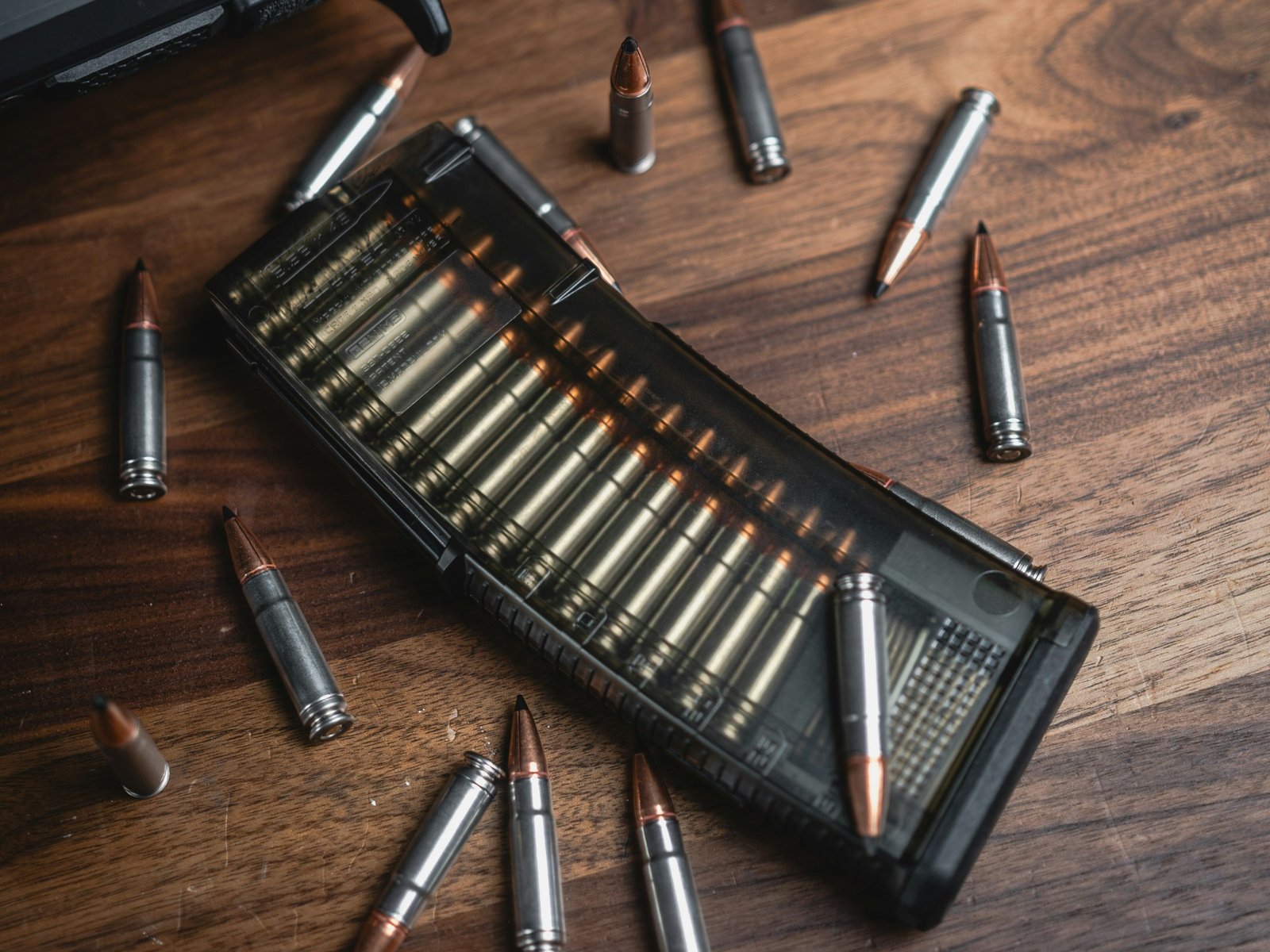
DOJ Sues to Block Colorado Gun Magazine Ban, Says Enforcement Violates Civil Rights
The federal government has stepped directly into Colorado’s gun law fight and I say it’s about damn time.
On May 6, 2026, the U.S. Department of Justice (DOJ) filed suit against the State of Colorado and the Colorado Department of Public Safety, asking a federal court to block enforcement of the state’s 15 round magazine limit and declare it unconstitutional. But the complaint goes further than that. The DOJ is also arguing that enforcing the law itself constitutes a violation of federal civil rights protections.
From the DOJ press release:
“Colorado’s ban on certain magazines is political virtue signaling at the expense of Americans’ constitutional right to keep and bear arms,” said Assistant Attorney General Harmeet K. Dhillon of the Justice Department’s Civil Rights Division.
The complaint is about one thing and one thing only: Colorado’s “Magazine Ban”. Passed into law in 2013 and codified under C.R.S. § 18-12-301, the law prohibits the sale, transfer, or manufacture of magazines capable of holding more than 15 rounds. A previous challenge to the law was dismissed by the Tenth Circuit in 2016 on standing grounds, meaning the court did not ultimately rule on the constitutionality of the magazine ban itself. What has not happened before is the federal government stepping in and framing the issue the way this complaint does. This, in my opinion, is brand new territory.
Colorado, like we’ve seen in other states, has justified the restriction by labeling these magazines “large-capacity”, framing them as some sort of rare and sophisticated firearm component. The DOJ rejects that outright. The complaint calls the term a mischaracterization and instead treats these magazines as standard components of commonly owned firearms. If a court accepts that magazines over 15 rounds are standard, not exceptional, then the law is no longer regulating an outlier component. It is restricting ordinary equipment.
From there, the complaint builds a record designed to fit squarely within the Supreme Court’s current Second Amendment framework.
The DOJ points to scale and prevalence. Tens of millions of these magazines exist nationwide. Millions are owned within Colorado. AR-15 platform rifles, described in the filing as among the most commonly owned firearms in the country, are typically sold with 20 or 30 round magazines. The majority of owners use them in that configuration. The same pattern applies to common handguns. Models like the Glock 17 exceed the 15 round threshold as a matter of standard design.
The complaint does not stop at ownership numbers. It ties magazines directly to function. Semi-automatic firearms are built to operate with detachable magazines. They load, cycle, and fire based on that design. The filing makes the point plainly: these firearms cannot function as intended without them. This moves the magazine out of the category of optional accessory and into the definition of the arm itself.
That sets up the central legal question under Heller and Bruen: whether something widely owned and used for lawful purposes can be banned outright. The DOJ’s answer is no, and the complaint is structured to make that conclusion difficult to avoid under current precedent.
But the most interesting and consequential part of this case is not the constitutional argument. It is what comes next…
The DOJ is not only asking the court to strike down the law. It is framing the enforcement of the law as a civil rights issue.
The complaint invokes 34 U.S.C. § 12601, a federal civil rights statute typically used in cases involving systemic misconduct by law enforcement agencies. The statute allows the federal government to intervene when there is a “pattern or practice” of conduct that deprives individuals of rights secured by the Constitution.
This means the DOJ is not simply asking whether the law is constitutional. It is asking whether the continued enforcement of the law constitutes an ongoing civil rights violation. That moves the issue beyond a standard policy question and into the broader debate of how constitutional rights are treated when states criminalize protected conduct.
The Bill of Rights does not place the Second Amendment in a separate category from the rest of the Constitution. A constitutional right does not stop being a civil right because it involves firearms. The DOJ’s complaint reflects that position directly. If the right is protected by the Constitution, and the government deprives individuals of that right through enforcement actions, then the federal government can argue that civil rights protections are implicated.
Colorado’s defense will likely follow a familiar path. The state will argue the law is a public safety measure and that it falls within its authority to regulate firearms and related components. It will likely argue that magazines are not “arms” in the constitutional sense and can be regulated separately. All stuff we’ve heard before. Expect an attempt to draw a line between the existence of the law and the actions of law enforcement enforcing it, with the goal of narrowing the scope of the case.
Those arguments will run into the framework the DOJ has already built into the lawsuit.
We will see the case ultimately turn on two issues.
First, whether magazines over 15 rounds fall within the definition of protected “arms” under the Second Amendment. The complaint is structured to answer that question with data, usage, and design.
Second, whether enforcement of a law that violates the Second Amendment can itself be treated as a civil rights violation under federal law. That question reaches beyond this statute. It goes to how far federal authority can extend when a state law conflicts with constitutional protections.
Here’s what I believe will happen next:
Colorado will move to dismiss, likely challenging both the constitutional claim and the DOJ’s use of the federal civil rights statute. A request for a preliminary injunction is likely, which would determine whether the magazine ban remains enforceable while the case proceeds. From there, the case is positioned for appellate review regardless of the initial outcome.
We all know this is not the only magazine ban in the country. Similar laws exist in multiple states and are already being challenged. What distinguishes this case is not the underlying issue, but how it is being pursued. The federal government is not waiting for private plaintiffs to carry the challenge forward. It is asserting its own authority and tying the outcome to federal civil rights enforcement. If the court accepts that framework, the implications extend beyond Colorado. The question will no longer be limited to whether a state can pass a particular restriction. It will include whether enforcing that restriction exposes the state to federal intervention.
The case was filed in the U.S. District Court for the District of Colorado and appears to have been assigned to Judge Daniel D. Domenico, a Trump appointee confirmed in 2019. Any ruling from the district court would be appealed to the U.S. Court of Appeals for the Tenth Circuit, which covers Colorado and has historically been more mixed on Second Amendment issues. From there, the case could reach the United States Supreme Court, particularly because it raises broader questions beyond magazine bans alone. If lower courts split on whether firearm restrictions can trigger federal civil rights liability under 34 U.S.C. § 12601, it would increase pressure on the Supreme Court to clarify not only the scope of Bruen, but whether enforcement of unconstitutional gun laws can itself constitute a civil rights violation.
The immediate question many people now have is how this connects to SB25-003, Colorado’s new semi-automatic firearm ban tied to an outrageous permit-to-purchase scheme. The DOJ’s theory in this case provides a roadmap. If a court accepts that magazines commonly used with those firearms are protected “arms,” and that enforcing a ban on them violates civil rights, the same logic can be extended to laws that condition access to those firearms in the first place. SB25-003 does not ban magazines directly, but it imposes a multi-step approval process before a person can acquire the firearms that rely on them. That raises the next question: whether requiring government permission, training mandates, and additional barriers before purchase can be treated the same way under the Second Amendment and federal civil rights law. This case does not decide that issue, but it puts the legal framework in place to challenge it. Serious legal challenges against SB25-003 will not come until the law is enacted on August 1, 2026, as it is difficult to challenge a law that does not yet exist.
For now, the issue in front of the court is narrower and more direct.
Whether Colorado can continue enforcing a law that prohibits possession and transfer of magazines that millions of Americans own, use, and rely on as part of standard firearm operation.
And whether enforcing that law is, in itself, a violation of the Constitution.
The DOJ’s Civil Rights Division’s Second Amendment Section enforces the Second Amendment. If you believe your right to keep and bear arms is being infringed, please submit a complaint through justice.gov/crt/second-amendment-section.
Help Us Hold the Line
We read every bill, track every hearing, and expose every attack on your rights.
Your donation powers the tools, outreach, and real time education to stop this madness.
The Second Amendment doesn’t defend itself. We do.