
Bipartisan Colorado Bill Authorizes FBI Surveillance Tied to Concealed Carry Permits
Don’t let the technical language fool you, Colorado lawmakers have introduced what could be one of the more consequential “behind the scenes” changes affecting gun owners in the state.
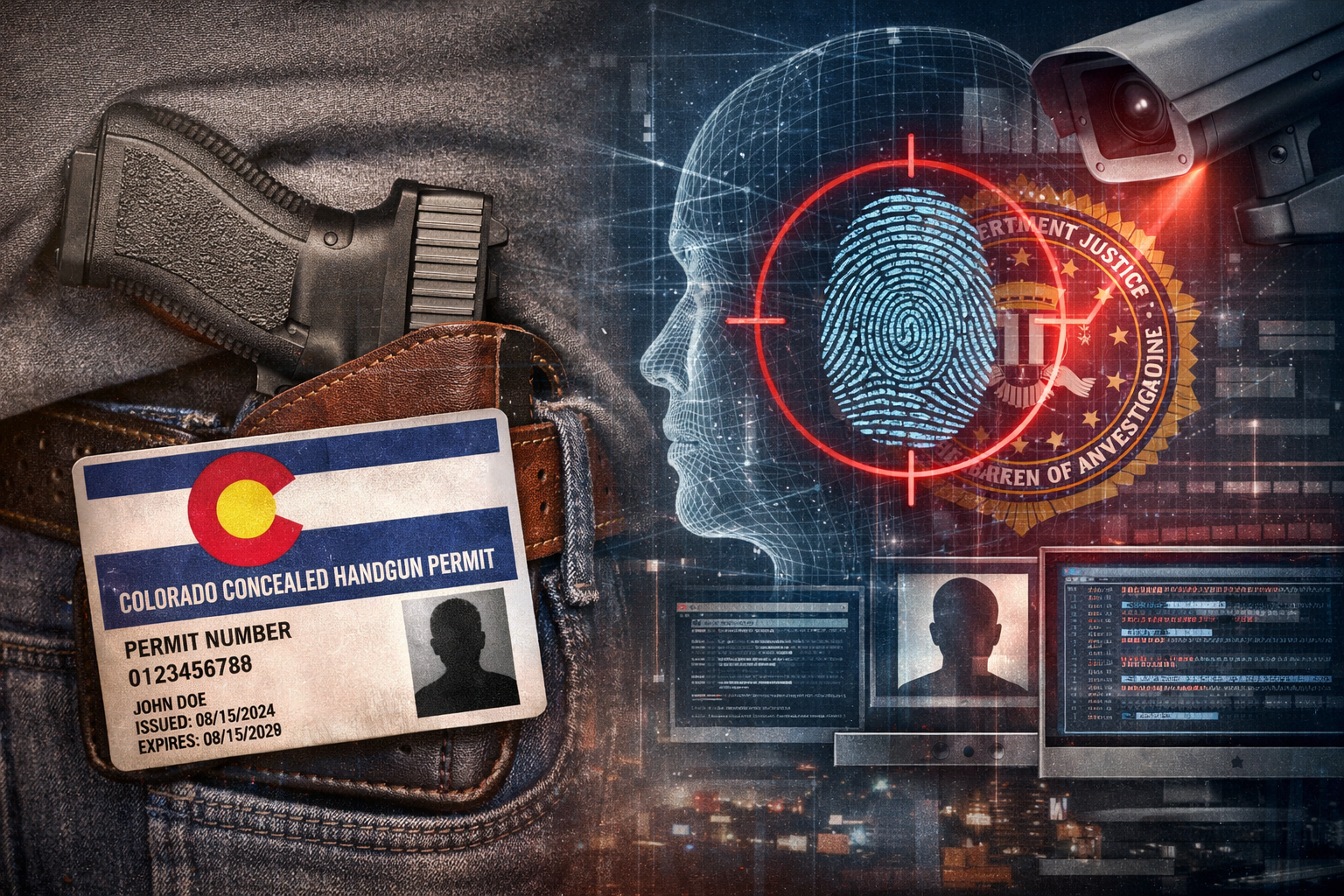
HB26-1108, “Colorado Bureau of Investigation Access Federal Fingerprint Search Service”, sponsored by a bipartisan group of two Republicans and two Democrats, would authorize the Colorado Bureau of Investigation (CBI) to participate in the FBI’s Rap Back Service, a continuous criminal history monitoring program. On its surface, that sounds like innocuous administrative housekeeping. But for gun owners, especially concealed handgun permit (CHP) holders, this could quietly transform the way background checks and eligibility are tracked in perpetuity.
Concealed handgun permits are one of the few remaining areas where Colorado still acknowledges that the right to carry exists…well….so long as the applicant passes a background check and plays by the rules. To obtain a CHP, applicants already submit fingerprints to the Colorado Bureau of Investigation through their county sheriff. That process has always been understood as a point-in-time vetting: you are checked, you qualify, and you’re issued a permit as long as your training is completed.
HB26-1108 quietly changes what that fingerprint submission could mean going forward.
By authorizing CBI to participate in the FBI’s Rap Back Service, the state would gain the ability to enroll those fingerprints into a permanent federal monitoring system. If that happens, CHP holders would no longer just be vetted once. They would be continuously monitored through a standing FBI identity file, not because they did anything wrong, but because they chose to carry legally.
And this isn’t some fringe concern affecting a handful of people.
Colorado has hundreds of thousands of concealed handgun permit holders statewide. Estimates consistently place the number around 650,000 active permits. Concealed carry in Colorado isn’t rare. In fact, over the past decade, CHP issuance has steadily increased, with noticeable spikes during periods of political uncertainty, public safety concerns, and just ahead of new regulatory changes. Between 2020 and 2024 alone, well over 150,000 Coloradans applied for or renewed concealed handgun permits. These are long-term, law-abiding citizens who have carried responsibly for years or even decades.
That means a policy shift like HB26-1108 doesn’t affect “a small subset of gun owners.” It potentially places hundreds of thousands of vetted, fingerprinted Coloradans into a framework of continuous federal identity surveillance tied directly to the exercise of a constitutional right.
When lawmakers describe Rap Back as a technical upgrade, they gloss over the scale of its reach. This wouldn’t apply to a narrow category of people or only those with sensitive job positions. It would also apply to a large, stable, and growing population of lawful gun owners.
Just as important, this surveillance would not be optional for future applicants.
Once CBI is authorized to participate in the FBI’s Rap Back Service, any new concealed handgun permit applicant whose fingerprints are submitted through the state system could be automatically enrolled. Future CHP holders wouldn’t simply undergo a background check and move on with their lives. They would be entered into a system of continuous federal monitoring by default, with their fingerprints tied to an active FBI identity file for as long as that enrollment remains in place.
To understand why that matters, it’s important to understand what Rap Back actually stores.
When fingerprints are enrolled, they are placed into the FBI’s Next Generation Identification (NGI) system. NGI is not a single static database. It is an integrated identity system that links biometric data to a living file. Fingerprints are the primary identifier, but they are not stored in isolation. Each fingerprint record is tied to a broader identity profile that includes a person’s full legal name, known aliases, date of birth, sex, race, physical descriptors, place of birth, and, when collected, citizenship information.
That biographic data doesn’t come from nowhere. It is compiled starting from that initial fingerprint-based background check. But it also includes any prior background checks, arrest submissions (even if no charges were ever filed or subsequently dropped), and court disposition records tied to that fingerprint identity. In other words, while fingerprints are the matching mechanism, the resulting file is a complete, identifiable profile.
If HB26-1108 moves forward unamended, the simple act of applying for a concealed carry permit in Colorado could become implicit consent to indefinite FBI surveillance, not because someone is suspected of wrongdoing, but simply because they exercised a constitutional right.
It should be noted that Colorado’s recently passed SB25-003 (the semiautomatic firearm ban “permit-to-purchase” law) does not require fingerprints under the statute, but the bill did initially require it before it was amended out for fiscal reasons so we know they want it. Instead, it mandates a name-based criminal history check conducted by a third-party vendor that applicants bring to the sheriff.
Gun ownership, and the right to carry, is not a privilege like occupying a sensitive government position. It is a right explicitly protected by both the U.S. Constitution and the Colorado Constitution.
This is a civil liberties issue. A background check is about eligibility. Surveillance over a constitutional right is about control. This would be a fundamental shift in the relationship between citizens and the state.
Help Us Hold the Line
We read every bill, track every hearing, and expose every attack on your rights.
Your donation powers the tools, outreach, and real time education to stop this madness.
The Second Amendment doesn’t defend itself. We do.